



Toytales Insights & Guides
Explore the latest trends, manufacturing guides, and plush toy industry insights.
How to Find a Reliable Bulk Plush Toy Supplier?
Table of Contents
- Define Your Bulk Plush Toy Requirements and Order Specifications
- Research Supplier Credentials, Experience, and Manufacturing Capacity
- Evaluate Plush Toy Quality, Materials, Safety, and Compliance
- Compare Pricing, Minimum Orders, Lead Times, and Shipping Options
- Request Samples and Finalize Terms Through a Clear Supplier Agreement
- FAQS
- Conclusion
- Related Posts
Choosing a reliable Bulk Plush Toy Supplier requires more than comparing catalog prices. It requires evidence.
Grand View Research estimated the global stuffed and plush toys market at approximately USD 7.9 billion in 2023. Its report also forecasts continued growth through 2030. Meanwhile, Circana reported that U.S. toy sales reached about USD 28.6 billion in 2023, despite an overall decline. These figures suggest strong demand, but they also increase supplier competition and quality risks.
A trustworthy supplier should provide clear factory details, production capacity, material specifications, and recent testing documents. Ask for a physical sample. Check its stitching, embroidery, stuffing density, odor, and seam strength. A soft bear can still hide loose threads or unsafe small parts. Request applicable testing for your target market, such as ASTM F963, CPSIA, or EN71 requirements. Confirm batch controls, packaging standards, minimum order quantities, and realistic lead times.
Steve Pasierb, president and CEO of The Toy Association, has said, “Play is not a luxury. It is a necessity.” That principle makes supplier responsibility especially important. Plush toys touch children, families, and brand reputations. A dependable partner should explain corrective actions, not merely promise perfection.
Do not trust polished photographs alone. Visit the factory when possible, or use an independent inspection company. Compare the approved sample with the mass-production goods. Small differences matter.
The uncomfortable truth is that the cheapest quote may become the most expensive decision. Supplier selection is not flawless. It is a process of checking, questioning, and documenting. This guide explains how to evaluate a Bulk Plush Toy Supplier with practical evidence, commercial judgment, and greater confidence.
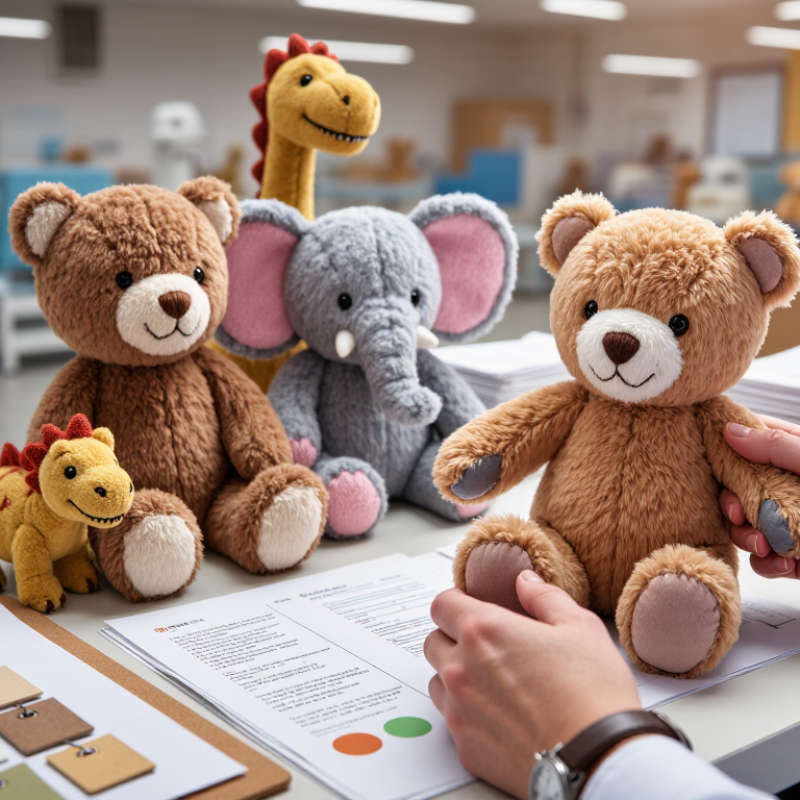
Define Your Bulk Plush Toy Requirements and Order Specifications
Before contacting a bulk plush toy supplier, turn your product idea into measurable requirements. State the animal, character style, dimensions, fabric, filling, colors, and intended age group. A soft bear is not enough. Specify a 25-centimeter body, embroidered eyes, short-pile fabric, and washable filling. Add reference sketches, color codes, and acceptable sample variations. In my sourcing work, vague briefs created avoidable revisions and delayed approvals. Small details matter.
Your order specification should cover quantity, size tolerance, packaging, labeling, delivery window, and inspection standards. Separate must-have features from flexible preferences. For example, allow a two-millimeter sewing tolerance, but reject loose threads or uneven facial embroidery. Ask for a pre-production sample and document every approved detail. Record carton dimensions, units per carton, and gross weight. These figures affect freight planning and warehouse space. Do not rely on verbal promises. Written records protect both sides.
Request material declarations, test reports relevant to your market, and a clear quality-control process. Verify whether the supplier can repeat the same texture and color across large batches. Sample approval is not batch approval. Plan a mid-production inspection when the order is substantial. It may feel excessive, yet one overlooked seam can multiply across thousands of toys. I once treated packaging as a minor issue; crushed boxes increased handling time and customer complaints. That mistake changed my checklist. Leave room for practical feedback, because the first specification is rarely perfect.
Define Your Bulk Plush Toy Requirements and Order Specifications
A clear specification helps suppliers prepare comparable quotations. This planning example shows how production lead time can change with order volume for a custom plush toy order.
Specification checklist: Confirm quantity, toy dimensions, fabric and filling materials, customization details, packaging, safety testing requirements, sample approval, delivery destination, and target delivery date before requesting a quotation.
Research Supplier Credentials, Experience, and Manufacturing Capacity
How to Find a Reliable Bulk Plush Toy Supplier?
Research Supplier Credentials, Experience, and Manufacturing Capacity
A reliable supplier should provide verifiable registration documents, factory details, and recent compliance records. Request test reports for fabric, stuffing, dyes, stitching strength, and small components. Safety requirements vary by destination, so generic certificates are not enough. Ask whether testing covers the exact plush toy design. According to the 2023 ISO Survey, more than 1.2 million organizations held ISO 9001 certificates worldwide. Certification is useful, but it does not replace production checks. Numbers need context.
Experience should be measured through comparable orders, not years alone. Ask for anonymized case details, sample revisions, defect rates, and delivery performance. A supplier producing promotional keychains may struggle with oversized plush toys or embroidered features. Review a physical sample under bright light. Check loose threads, seam tension, odor, fabric recovery, and embroidery alignment. Small flaws often become expensive at scale.
Manufacturing capacity requires evidence. Request a process flow, monthly output by product type, equipment lists, staffing levels, and peak-season plans. The 2024 Global Toy Market report from Circana highlights continued pressure on value and product quality, making cost-only comparisons unreliable. Confirm whether stuffing, sewing, embroidery, inspection, and packing happen in-house. Ask for a pilot order before committing to a large quantity. I would also leave room for doubt: stated capacity can exceed practical capacity when several buyers share the same production line. On-site or independent audits remain worthwhile.
Evaluate Plush Toy Quality, Materials, Safety, and Compliance
Finding a reliable bulk plush toy supplier starts with evidence, not attractive product photos. The U.S. Consumer Product Safety Commission reported an estimated 231,100 toy-related injuries in 2023. This figure shows why safety checks must begin before price negotiations. Ask for recent laboratory reports, production samples, and traceable batch records. Small parts matter.
Inspect stitching, seams, stuffing, and attached eyes by hand. Pull the nose, rub printed areas, and wash a sample when possible. Loose fibers, sharp plastic edges, strong odors, or uneven filling indicate weak process control. Materials should be clearly identified, including outer fabric, dyes, thread, and fiberfill. OEKO-TEX-style chemical screening can support claims, but it does not replace required toy testing. A supplier can pass one sample and still produce inconsistent bulk goods. That is an uncomfortable gap.
For shipments to the United States, request testing against ASTM F963-23, including flammability, mechanical hazards, and heavy-metal limits. For Europe, review EN 71 results and applicable REACH chemical restrictions. The European Commission’s Safety Gate reports regularly identify toys among the most frequently notified product categories, reinforcing the need for documented compliance. Check the laboratory’s accreditation, report dates, tested model numbers, and age grading. Do not accept a generic certificate. I would also inspect random cartons during production, because paperwork can look perfect while a seam quietly fails.
How to Find a Reliable Bulk Plush Toy Supplier? - Evaluate Plush Toy Quality, Materials, Safety, and Compliance
Use this screening table to compare bulk plush toy suppliers. Requirements may vary by destination market, product age grade, toy design, packaging, and applicable legislation.
| Evaluation Area | Key Criterion | Practical Benchmark or Requirement | Recommended Verification Method | Supplier Evidence to Request | Risk Level |
|---|---|---|---|---|---|
| Product Quality | Appearance and workmanship | Consistent shape, color, embroidery, stuffing distribution, and seam alignment across the production lot; no visible stains, exposed filling, loose threads, or sharp finishing defects. | Inspect pre-production samples and randomly selected units from a finished batch under consistent lighting. | Approved reference sample, inspection checklist, and batch inspection photographs. | Medium |
| Product Quality | Seam and attachment strength | Critical seams, eyes, noses, bows, ribbons, and other attachments should remain secure during age-appropriate abuse testing and normal handling. | Request testing performed by a competent laboratory or qualified quality team using the destination market’s applicable toy standard. | Test report identifying the exact product, components, sample quantity, and test methods. | High |
| Materials | Outer fabric composition | Material composition, pile height, color, texture, and weight should match the approved specification. Fabric should not shed excessively during handling. | Compare production fabric with the approved sample and verify composition through laboratory analysis when required. | Material specification sheet, fabric composition record, and color approval sample. | Medium |
| Materials | Filling material | Filling should be clean, evenly distributed, free from visible foreign matter, and enclosed so that it cannot escape through normal use or reasonably foreseeable handling. | Open selected samples when appropriate, inspect the filling, and perform seam and containment checks. | Filling specification, supplier declaration, batch traceability record, and inspection results. | High |
| Safety | Small parts and choking hazards | Products intended for children under three years must be assessed especially carefully because detachable eyes, noses, accessories, and fasteners may present choking hazards. | Conduct small-parts, tension, torque, pull, and abuse testing according to the applicable destination-market requirements and age grade. | Age-grading rationale, small-parts test results, and component attachment test records. | High |
| Safety | Flammability | The finished toy should meet the flammability requirements applicable to its destination market and product category; fabric, fur, stuffing, and decorative materials all require consideration. | Submit a representative finished product to an accredited or otherwise competent laboratory for the relevant flammability method. | Current flammability test report covering the final materials and construction. | High |
| Chemical Safety | Restricted substances | Materials, coatings, prints, dyes, plastics, and metal components should comply with restrictions applicable in the destination market, including requirements for lead, certain phthalates, formaldehyde, and other regulated substances where relevant. | Use risk-based chemical testing on the finished product and review the bill of materials before production. | Recent chemical test report, bill of materials, material declarations, and corrective-action records. | High |
| Compliance | Destination-market conformity | The supplier should identify and apply the rules for the intended market, such as applicable toy safety, chemical, labeling, documentation, and importer obligations. | Check whether the compliance file covers the exact model, age grade, materials, packaging, and sales destination. | Declaration of conformity where required, technical file, applicable test reports, and product labeling artwork. | High |
| Compliance | Traceability and production control | Each bulk shipment should be traceable to a purchase order, production batch, material records, inspection results, and shipment date. | Review batch coding, production records, incoming-material controls, and final inspection procedures. | Batch records, inspection reports, lot codes, quality manual, and corrective-action procedure. | Medium |
| Supplier Reliability | Pre-shipment inspection and defect control | A written inspection plan should define sampling, acceptable quality limits, critical defects, major defects, minor defects, packaging checks, and functional tests. | Confirm that inspection criteria are agreed before production and that failed inspections trigger documented corrective action. | Inspection standard, signed inspection report, defect photographs, and corrective-action report. | Medium |
| Supplier Reliability | Production consistency | The bulk order should match the approved golden sample in dimensions, color, fabric, accessories, filling density, labels, and packaging. | Compare samples from the start, middle, and end of production with the approved reference sample. | Golden sample approval record, production sample photos, and deviation approval process. | Medium |
| Packaging and Labeling | Warnings, instructions, and product information | Labels and warnings should be legible, durable, accurate, translated where required, and appropriate for the product’s age grade and destination market. | Review final artwork and inspect labels on packed units before shipment. | Approved packaging artwork, label specification, warning review, and packaging inspection report. | High |
| Testing Program | Laboratory competence and report validity | Testing should be performed by a laboratory competent for the requested methods, using a report that clearly identifies the tested product and current production materials. | Verify laboratory details, report scope, test dates, sample descriptions, photographs, and method references. | Complete test report, laboratory accreditation or competence information, and sample submission record. | High |
| Commercial Reliability | Capacity, lead time, and communication | The supplier should provide a realistic production schedule, defined minimum order quantity, material lead times, inspection milestones, and a process for handling delays or specification changes. | Compare the written quotation and production plan with actual sample and pilot-order performance. | Quotation, production timeline, capacity statement, order terms, and escalation contacts. | Medium |
Note: Screening benchmarks are practical purchasing controls rather than a substitute for legal advice or destination-market testing. The applicable requirements depend on the product design, intended age group, materials, packaging, and country or region of sale.
Compare Pricing, Minimum Orders, Lead Times, and Shipping Options
Finding a reliable bulk plush toy supplier starts with comparable numbers, not polished promises. Ask for unit prices at several quantities, such as 500, 2,000, and 10,000 pieces. Request a written breakdown for materials, stitching, embroidery, packaging, sampling, and tooling. A low quote may exclude important costs. I learned this after comparing two quotations with different packaging assumptions. The cheaper offer was not cheaper after carton fees were added. Small details matter.
Minimum order quantity (MOQ) should match your sales forecast and storage capacity. A factory may accept a small trial order but charge more per piece. Ask whether mixed colors, designs, or sizes count toward one MOQ. Confirm sample fees and whether they are credited against production.
Lead time needs separate dates for sample approval, production, inspection, and dispatch. In my experience, vague schedules create more risk than slightly higher prices. Build extra days for revisions.
I sometimes underestimated approval delays, especially when embroidered details needed correction. That mistake was avoidable.
Compare shipping options using the same destination and carton data. Ask for estimated weight, carton dimensions, shipping method, transit time, insurance, and customs responsibilities. Air freight is faster, while sea freight usually suits larger orders. Courier services may fit smaller shipments, but availability and rates change.
Request recent shipment records or references, and verify quality with a production sample. Do not rely on photos alone. A clear contract should record tolerances, inspection standards, payment stages, and remedies for defects.
Leave room for questions. Good sourcing is not perfectly linear.
Request Samples and Finalize Terms Through a Clear Supplier Agreement
How to Find a Reliable Bulk Plush Toy Supplier?
Requesting samples is one of the safest ways to assess a bulk plush toy supplier. Ask for several units from the proposed production line, not only a showroom sample. Examine fabric softness, stitching strength, filling distribution, embroidery accuracy, and smell. Check the toy after gentle pulling and repeated handling. Small faults often reveal larger production risks.
A clear supplier agreement should record every important detail. Include the approved sample, materials, dimensions, colors, packaging, order quantity, production schedule, inspection method, payment stages, and defect-handling process. Define what happens if the shipment differs from the sample. Require written approval before any material or design change. In practice, buyers sometimes focus heavily on price and overlook packaging damage or inconsistent stuffing. That mistake can become expensive. I would also add a realistic inspection window and clear evidence requirements, such as photos, test records, and batch details.
Tips: Compare samples side by side. Keep one approved sample securely. Ask who controls final quality. Confirm shipping terms in writing. Leave room for minor variation, but define acceptable limits. A strong agreement protects both sides, yet it cannot replace careful communication. Sometimes, one overlooked measurement changes the entire product appearance.
FAQS
State the animal, style, dimensions, fabric, filling, colors, and intended age group. A 25-centimeter body is clearer than “small.” Add sketches, color codes, and acceptable sample variations.
Specify sewing tolerance, embroidery standards, filling distribution, loose-thread limits, and packaging requirements. For example, allow two millimeters of size variation. Reject uneven eyes or open seams.
Written records reduce misunderstandings about materials, quantities, packaging, and delivery dates. Do not rely on verbal promises. Small details matter.
Request prices for several quantities, such as 500, 2,000, and 10,000 pieces. Ask whether mixed colors or sizes share one minimum order. Check sampling, packaging, and tooling fees.
Separate dates for sampling, approval, production, inspection, and dispatch. Add extra days for revisions. Approval delays happen.
Request carton dimensions, units per carton, gross weight, shipping method, transit time, and insurance details. Confirm customs responsibilities in writing. These figures affect warehouse space.
Compare several units from the proposed production line. Check softness, stitching, filling balance, embroidery, smell, and handling strength. Photos alone are insufficient.
Include the approved sample, materials, dimensions, colors, quantity, packaging, payment stages, and inspection method. Define remedies for defects and changes. Require written approval for material changes.
No. Sample approval does not guarantee batch consistency. Consider a mid-production inspection for substantial orders. One missed seam can multiply quickly.
Ignoring carton damage, underestimating approval time, or comparing incomplete quotations can increase costs. My checklist was once incomplete. Practical feedback may improve the original specification.
Conclusion
Finding a reliable Bulk Plush Toy Supplier starts with clearly defining your product requirements, including toy size, design, materials, colors, quantities, packaging, labeling, and delivery schedule. Well-prepared specifications help suppliers understand your expectations and make accurate quotations. You should then research each supplier’s experience, production capabilities, quality control procedures, and ability to handle large or repeat orders. A supplier with suitable manufacturing capacity and clear communication is more likely to provide consistent service.
Quality and safety should be carefully evaluated by reviewing materials, stitching, filling, durability, and applicable product standards. Request samples before placing a large order, and compare pricing, minimum order quantities, production lead times, payment terms, and shipping options. Finally, confirm all details in a clear supplier agreement covering product specifications, inspection procedures, delivery responsibilities, and procedures for resolving issues. This structured approach can help you select a dependable partner and reduce risks throughout the purchasing process.

Blog Tags:
Instant Query