



Toytales Insights & Guides
Explore the latest trends, manufacturing guides, and plush toy industry insights.
Top B2B Toy Manufacturing Factories for Global Buyers?
Table of Contents
- How Global Buyers Define a Qualified B2B Toy Manufacturing Factory
- Where Major Toy Manufacturing Hubs Differ in Cost, Materials, and Capacity
- Which Factory Capabilities Fit Plush, Plastic, Wooden, and STEM Toys
- How CPSIA’s 100 ppm Lead Limit and 90 ppm Coating Limit Guide Factory Checks
- How Buyers Compare MOQ, Production Capacity, Lead Time, and Audit Records
- FAQS
- Conclusion
- Related Posts
Choosing a B2B Toy Manufacturing Factory is not just a price comparison. It is a decision about repeatable quality, clear communication, and production capacity. A polished sample can look convincing under bright showroom lights. The real test comes later: matching that sample across cartons, color batches, and delivery dates.
Toy-industry analyst Richard Gottlieb, founder of Global Toy Experts, offers a useful perspective on evaluating suppliers. His industry analysis points to a practical lesson: buyers should assess the business behind a product, not the product alone. This is a paraphrase of that perspective, not a verbatim quotation. For global buyers, that means asking how a factory handles tooling changes, material records, in-line inspections, and production delays. Request concrete evidence, such as a sample inspection report or a documented corrective-action example. Then check whether the answers stay consistent across sales, engineering, and quality teams.
Details matter. A loose wheel, uneven paint, or unreadable carton label can signal a process gap. So can vague replies about lead times. But no supplier is flawless, and a confident presentation is not proof. Buyers should compare factories against the same product brief and record what remains uncertain. That takes time. It can also reveal whether a factory asks useful questions before quoting, rather than promising everything immediately.
This guide examines leading B2B toy manufacturing factories for international buyers, with attention to product capabilities, communication, quality systems, and practical fit. The goal is not to name one universal winner. It is to help buyers find a partner whose strengths match their product, volume, and expectations.
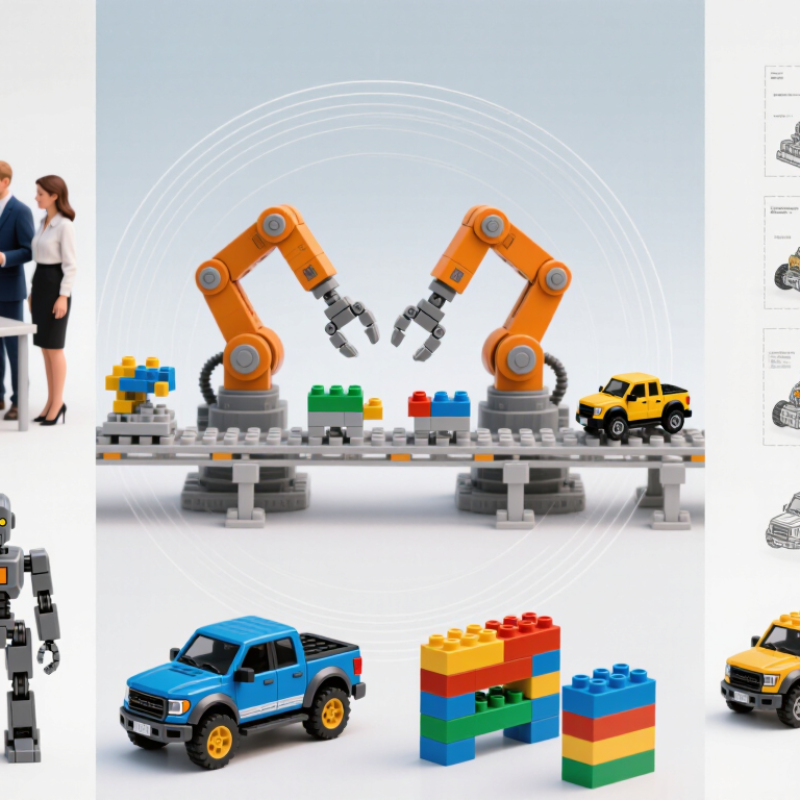
How Global Buyers Define a Qualified B2B Toy Manufacturing Factory
A qualified B2B toy manufacturing factory can explain how a product moves from drawing to packed carton. Buyers should ask for material specifications, sample approval steps, and clear records for each production stage. Details matter. A reliable team can show how it checks small parts, paint coverage, seams, and packaging—not just finished units. Ask to see recent inspection records and how rejected items are handled.
Production capacity matters, but quoted capacity needs context. Ask how the factory manages peak-season orders, changes to a design, and delays in supplied materials. A short video call from the production floor may clarify more than a polished brochure. Check whether the sample matches the proposed materials and finish, then confirm that approved details are recorded before mass production. Requirements vary by destination market, so request relevant test documentation and verify its scope with a qualified reviewer.
Communication is part of quality. A useful supplier names a contact, answers specific questions, and flags risks early. One unanswered question may be a warning; one late reply is not always proof of poor performance. Factories are not flawless. Buyers should look for honest explanations, corrective actions, and records that connect a problem to its fix. Even careful buyers can overlook a detail, such as carton strength during long-distance handling. Recheck the assumptions.
Where Major Toy Manufacturing Hubs Differ in Cost, Materials, and Capacity
Toy production hubs differ less by headline factory price than by the full cost of materials, labor, and delivery. China offers broad supplier networks for plastics, molded parts, packaging, and electronics, which can simplify complex orders. Vietnam is a growing option for labor-intensive assembly, though some components may still arrive from elsewhere. That changes lead times. A lower unit quote can hide extra freight, handling, and coordination costs.
The World Bank’s 2023 Logistics Performance Index rated China 3.7 out of 5 and Vietnam 3.3 for overall logistics performance. These scores offer context, not a factory-level guarantee. India and Mexico may suit buyers seeking different labor pools or closer access to particular markets, but capacity and material availability vary by region. Ask factories to identify where resin, fabric, paint, and packaging come from. Then compare landed costs, production schedules, and sample consistency—not just hourly wages. Small details matter. A delay in one molded part can leave finished assembly lines waiting. I would not assume the cheapest hub wins; that assumption can fail when specifications change or a shipment misses its window. Some uncertainty remains, even after careful checks.
Which Factory Capabilities Fit Plush, Plastic, Wooden, and STEM Toys
A factory suited to plush toys needs more than sewing capacity. Check whether operators can keep seams even around ears, limbs, and small curved pieces. Ask how stuffing weight is controlled and how fabric lots are tracked. Request a preproduction sample with the intended stitching and labels. Small details matter. Loose threads can signal weak finishing controls, though one sample cannot reveal every production issue.
Plastic toys depend on reliable mold maintenance, consistent material handling, and careful checks for sharp edges or incomplete parts. Ask to review mold records and measurements from production runs. Color matching under different lighting can be tricky. A swatch that looks right in an office may shift beside a shop window. Wooden toy production calls for smooth sanding, clean joints, and documented checks on coatings and surface finish. Run a hand over corners and drilled holes; rough spots are easy to miss in photos.
STEM toys add another layer: parts must fit together repeatedly, and instructions should match the actual kit. Ask how components are counted, packed, and checked against the assembly guide. A pilot run can reveal missing pieces or confusing steps before a larger order. Not every factory will excel across all four materials. That is worth admitting early. Compare samples, process records, and corrective-action examples, rather than relying on polished product images alone.
Top B2B Toy Manufacturing Factories for Global Buyers? Which Factory Capabilities Fit Plush, Plastic, Wooden, and STEM Toys
| Capability Area | Plush Toys | Plastic Toys | Wooden Toys | STEM Toys |
|---|---|---|---|---|
| Core production strengths | Pattern making, fabric cutting, sewing, stuffing, and finishing. | Tooling, injection molding or other suitable molding processes, part finishing, and assembly. | Wood selection, cutting, machining, sanding, finishing, and assembly. | Component sourcing, mechanical assembly, electronics integration where needed, and kit packing. |
| Materials and components | Commonly uses woven or knitted fabrics, filling, thread, and accessories such as eyes or fasteners. | Uses plastics selected for the product design and intended use; may combine molded parts with other materials. | Uses solid wood or engineered wood, with material choice depending on design and product requirements. | May combine plastic, wood, metal, printed materials, electronic components, and fasteners. |
| Design and customization | Custom shapes, fabric choices, colors, embroidery, labels, and packaging are common options. | Custom shapes and colors can require product design work and dedicated molds or tooling. | Customization may include shape, engraving, color, finish, and set configuration. | May include custom experiments, parts, learning activities, instructions, and packaging; electronics add design and validation work. |
| Quality checks to discuss | Stitching and seam strength, attachment security, filling consistency, appearance, and cleanliness. | Part dimensions, molding defects, edges, fit between components, assembly, and function. | Surface finish, splinters, edge smoothness, component fit, coating quality, and assembly. | Part completeness, assembly, mechanical function, instructions, and electrical function when applicable. |
| Safety and compliance planning | Discuss age grading, small parts or attachments, flammability requirements, and applicable chemical limits. | Discuss age grading, small parts, mechanical hazards, material restrictions, and relevant chemical requirements. | Discuss age grading, splinter and pinch hazards, coatings, small parts, and applicable chemical limits. | In addition to toy safety, assess electrical, battery, and radio-related requirements if those features are included. |
| Standards to check by destination | Requirements depend on destination and product; examples include ASTM F963 in the United States and EN 71 in the European Union. | Requirements depend on destination and product; examples include ASTM F963 in the United States and EN 71 in the European Union. | Requirements depend on destination and product; examples include ASTM F963 in the United States and EN 71 in the European Union. | Check applicable toy standards plus any additional rules for electrical or wireless features in each sales market. |
| Packaging and kitting | Can support folding, protective bags, hang tags, and retail or bulk packing. | Can support component assembly, inserts, protective packing, and retail or bulk packing. | Can support part sets, instruction sheets, protective packing, and retail or bulk packing. | Strong kitting capability is important for grouping parts, activity materials, instructions, and any included electronics. |
| Best-fit factory profile | A sewing-focused facility with experienced sample development and reliable finishing controls. | A molding and assembly facility with suitable tooling expertise and process controls. | A woodworking facility with controlled machining, sanding, finishing, and assembly processes. | A capable assembler or specialist partner able to manage multiple components, documentation, and functional checks. |
| Buyer due diligence | Request a representative sample, material details, production photos, and test documentation relevant to the product. | Review tooling ownership and maintenance terms, sample approval, material specifications, and product-specific test records. | Confirm wood and finish specifications, sample quality, process controls, and any sourcing documentation required. | Confirm component traceability, version control, functional testing, instruction accuracy, and responsibility for compliance testing. |
Buyer note: This is a capability-fit guide, not a ranking of individual factories. Safety standards and testing depend on the toy’s design, age grading, materials, features, and destination market. Verify current requirements and request product-specific documentation before placing an order.
How CPSIA’s 100 ppm Lead Limit and 90 ppm Coating Limit Guide Factory Checks
Top B2B Toy Manufacturing Factories for Global Buyers?
How CPSIA’s 100 ppm Lead Limit and 90 ppm Coating Limit Guide Factory Checks
For U.S.-bound children’s toys, two lead limits shape practical factory checks. CPSIA caps lead in accessible component parts at 100 parts per million. Lead in paint and similar surface coatings is limited to 90 ppm. These figures come from U.S. Consumer Product Safety Commission guidance on lead in children’s products and paint. Different materials, different limits.
A buyer should ask how each toy component is identified, sampled, and linked to its test report. A bright-painted wooden wheel needs coating checks; an accessible metal fastener needs a substrate check. Request reports from a CPSC-accepted, ISO/IEC 17025-accredited laboratory, and confirm they match the actual materials and production lot. A report for an earlier sample may not represent today’s batch. Paperwork can miss that gap.
Factory checks should also review supplier declarations, material changes, and records for incoming lots. Ask what triggers retesting, especially after a coating or component supplier changes. CPSIA limits are not factory-wide averages: a compliant result for one part cannot establish compliance for every part. CPSC guidance gives the thresholds, but buyers still need a clear sampling plan and traceable records. There is no perfect shortcut.
CPSIA Lead Limits Used in Toy Factory Checks
Regulatory lead limits for children’s product materials, in parts per million (ppm).
CPSIA generally limits lead content in accessible children’s product component parts to 100 ppm and lead in paint or similar surface coatings to 90 ppm. These are regulatory limits, not factory test results; buyers should verify applicable requirements and request test reports for relevant materials.
How Buyers Compare MOQ, Production Capacity, Lead Time, and Audit Records
For global buyers, a low minimum order quantity is useful only if the quoted price remains workable at that volume. Ask for tiered pricing and confirm whether packaging, color changes, or product variations affect the MOQ. Check production capacity against the factory’s current schedule, not just its maximum monthly output. A line making 40,000 units monthly may have little room during peak season. Request a sample production plan with key milestones.
Tips: Compare the same product specifications across factories. Ask how many units they can schedule for your target shipping window, and what could delay that plan. Get answers in writing.
Lead time should include material sourcing, sampling, production, inspection, and packing. Clarify when the clock starts; “30 days” can mean different things. Audit records also need context. Review the audit date, scope, findings, and corrective actions, rather than relying on a pass label alone. Where possible, match records to the site and production process used for your order.
Capacity figures can look precise but change with staffing and material availability. Buyers sometimes focus too heavily on the fastest estimate. A more useful comparison includes recent delivery performance and a clear plan for delays.
FAQS
It should show how a product moves from drawing to packed carton. Ask about materials, sample approval, inspections, and rejected items. Details matter.
Ask how peak-season orders, design changes, and material delays are handled. A brief production-floor video call can add useful context.
Check its materials and finish against the proposed specifications. Record approved details before mass production begins. Small differences matter.
U.S. guidance sets a 100 ppm limit for lead in accessible component parts and 90 ppm for paint or similar coatings. Different parts need different checks.
Confirm that it covers the actual materials and production lot. Ask for reports from an appropriately accredited laboratory. Old reports may not match today’s batch.
Ask what happens when a coating or component supplier changes. Incoming-lot records can help trace material changes. Paper can lag.
Look for a named contact, specific answers, and early warnings about risks. One late reply is not proof of poor performance.
Ask for the rejected-item process, corrective action, and records linking the issue to its fix. Factories are not flawless.
Carton strength during long-distance handling can be easy to miss. I might overlook it too, so recheck the assumption.
Conclusion
Choosing a qualified B2B Toy Manufacturing Factory means looking beyond price to assess product expertise, quality systems, communication, and the ability to meet export requirements. Manufacturing hubs can differ in labor and material costs, supplier access, production scale, and specialization, so buyers should match a location to their budget and product needs. Plush toys call for reliable textile sourcing and stitching controls, while plastic, wooden, and STEM toys require suitable molding, woodworking, assembly, or component-management capabilities.
Before placing an order, buyers should confirm that the factory can support relevant safety checks, including CPSIA limits of 100 ppm for lead in accessible components and 90 ppm in surface coatings, where applicable. A practical comparison also covers minimum order quantity, verified production capacity, realistic lead times, inspection processes, and current audit records. Reviewing samples and discussing testing documentation early can help buyers identify a factory that can deliver consistent quality and dependable production at scale.

Blog Tags:
Instant Query