



What Are the 2026 Best Educational Plastic Toys? This question deserves more than a colorful product list. The strongest choices should make learning visible through play, not through loud claims on packaging. They may support counting, sorting, balance, language, spatial reasoning, or early problem-solving. A child might stack translucent blocks, connect gears, or classify animal figures by habitat. These simple actions can reveal genuine learning value.
This guide will examine Educational Plastic Toys through practical, evidence-informed standards. We will consider age suitability, material quality, durability, cleanability, and the clarity of each toy’s learning purpose. Designs should use smooth edges, secure parts, and non-toxic materials supported by reliable manufacturer information. Adult supervision still matters, especially when toys include small pieces. It matters greatly.
Hands-on testing should also ask whether children can play independently after a short demonstration. A toy that requires constant adult correction may look educational but feel frustrating. We will compare open-ended play with toys offering structured challenges. Open-ended options often encourage creativity, although they can make progress harder to measure. That limitation deserves attention.
No ranking is flawless. Children develop differently, and family budgets, space, and cultural interests affect every choice. Some popular toys may be durable but repetitive. Others may inspire imagination yet break sooner than expected. By combining expert guidance, careful observation, and transparent product details, this 2026 overview aims to help families choose thoughtfully rather than chase fashionable labels.
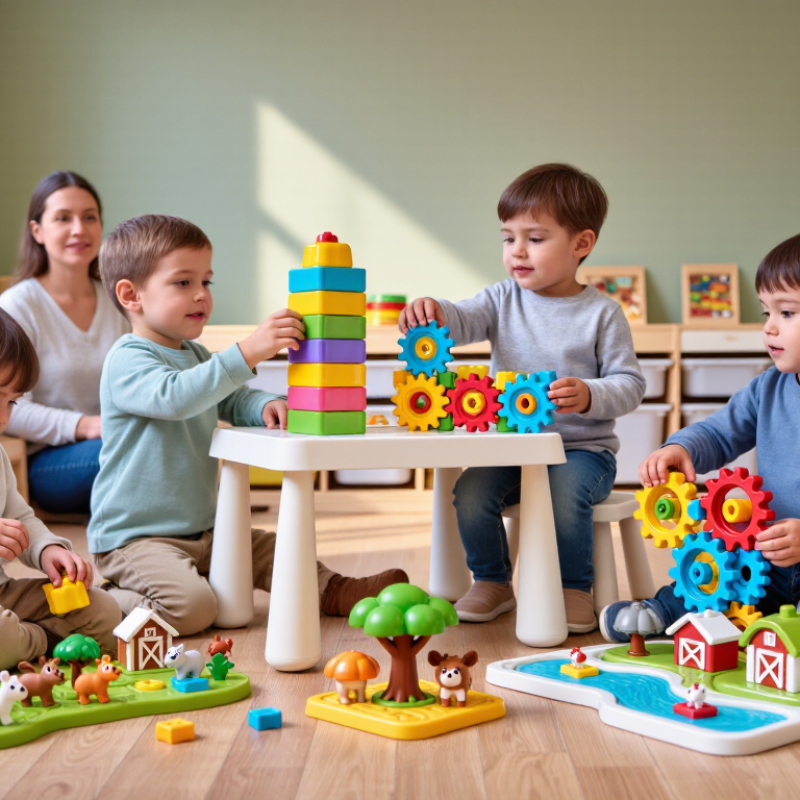
Defining Educational Plastic Toys in 2026
In 2026, educational plastic toys should mean more than colorful objects with numbers printed on them. They should create purposeful learning through touching, building, sorting, testing, and revising. A useful toy gives children visible feedback. A tower falls. A pattern works. A small mistake becomes information.
The OECD’s PISA 2022 report recorded a 15-point decline in average mathematics performance across OECD countries since 2018. This strengthens the case for hands-on problem solving, but toys cannot repair education alone. The strongest plastic toys support spatial reasoning, early numeracy, language, and fine-motor control without turning play into a worksheet. They should also include clear age guidance, smooth edges, durable construction, and materials tested against recognized safety standards, such as ASTM F963.
Safety matters.
In practice, I would define a high-quality 2026 toy by its learning behavior, not its packaging claims. It should invite open-ended use, allow repeated attempts, and remain understandable without constant adult instruction. Accessibility also matters, including easy-grip parts and visual or tactile cues. The UNICEF and LEGO Foundation Learning through Play report emphasizes active, engaging, meaningful, iterative, and socially interactive play. Still, this definition has limits. A beautifully designed toy may become boring after three uses. A simple sorting set may produce deeper learning than a complicated electronic product. Caregiver observation remains essential, and more independent testing would improve these judgments.
What Are the 2026 Best Educational Plastic Toys? - Defining Educational Plastic Toys in 2026
| Toy Category | Typical Age Range | Primary Learning Domains | Educational Features | Recommended Plastic Design | Observable Learning Outcomes | Key Safety Considerations | 2026 Selection Value |
|---|---|---|---|---|---|---|---|
| Interlocking Construction Blocks | 3–8 years | Spatial reasoning, fine-motor coordination, creativity, early engineering | Open-ended building, symmetry, balance, pattern creation, and structural problem-solving | Rounded edges, consistent connections, washable surfaces, and multiple shapes | Children plan, assemble, revise, and explain stable structures | Avoid small parts for children under 3; inspect pieces for cracks or sharp edges | Supports hands-on STEM learning without requiring screens or batteries |
| Magnetic Construction Tiles | 3–10 years | Geometry, spatial visualization, design thinking, collaboration | Flat shapes transform into three-dimensional forms and encourage experimentation | Fully enclosed magnets, durable welds, translucent color options, and varied polygons | Children identify shapes, compare faces, build solids, and test designs | Magnets must remain securely enclosed; damaged pieces should be removed immediately | Makes abstract geometry visible through tactile, reusable construction |
| Counting and Sorting Manipulatives | 3–6 years | Numeracy, classification, one-to-one correspondence, visual discrimination | Counting objects, grouping by attributes, comparing quantities, and simple patterns | High-contrast colors, varied sizes and shapes, smooth washable pieces | Children count objects accurately, sort by rules, and describe more or fewer | Use oversized pieces for younger children and provide supervised play | Provides concrete foundations for mathematics before symbolic notation |
| Pattern and Logic Boards | 4–8 years | Sequencing, logical reasoning, memory, early computational thinking | Visual sequences, matching tasks, rule discovery, and progressive challenges | Clearly differentiated pieces, tactile markings, and self-checking layouts | Children identify rules, predict missing elements, and explain their reasoning | Parts should be large enough for the stated age range and resistant to breakage | Introduces algorithmic thinking through unplugged, screen-free activities |
| Early Robotics and Coding Sets | 5–10 years | Sequencing, cause and effect, engineering, problem-solving | Command sequences, sensors, repeatable actions, and error correction | Modular parts, protected electronics, replaceable batteries, and simple controls | Children create instructions, test outputs, locate errors, and improve solutions | Battery compartments should be secured; small electronic parts require supervision | Connects physical construction with foundational coding concepts and iterative design |
| Gear, Pulley, and Mechanism Sets | 5–10 years | Mechanical reasoning, physics, fine-motor skills, design thinking | Demonstrates motion, force transfer, speed, direction, and simple machines | Large gears, guarded moving areas, low-friction axles, and visible mechanisms | Children predict movement, alter variables, and explain mechanical relationships | Moving parts should minimize pinch points and be appropriate for the recommended age | Offers tangible physics learning and encourages testing rather than memorization |
| Role-Play and Community Sets | 3–7 years | Language, social-emotional development, communication, imagination | Supports storytelling, turn-taking, perspective-taking, and cooperative play | Durable, realistic but open-ended accessories with diverse figures and settings | Children create narratives, negotiate roles, use new vocabulary, and resolve conflicts | Avoid sharp accessories and small loose parts for younger children | Balances academic learning with communication, empathy, and collaborative play |
| Fine-Motor Lacing and Fastening Boards | 3–6 years | Hand strength, bilateral coordination, self-care readiness, concentration | Practice with laces, buttons, zippers, clips, and coordinated hand movements | Rounded openings, flexible components, textured grips, and easy-to-clean surfaces | Children complete increasingly complex fastening sequences independently | Fasteners must be firmly attached; cords should be short and securely fixed | Useful for practical independence and pre-writing motor development |
| Water and Measurement Play Sets | 3–7 years | Early science, measurement, prediction, sensory learning | Explores volume, flow, floating, sinking, comparison, and basic experimentation | Mold-resistant, drainable, transparent or graduated containers with rounded edges | Children make predictions, compare quantities, record observations, and revise ideas | Adult supervision is required around water; dry and clean pieces after use | Turns everyday sensory play into accessible inquiry-based science |
| Inclusive Puzzle and Matching Boards | 2–6 years | Visual perception, vocabulary, memory, problem-solving, fine-motor control | Large knobs, tactile contrasts, matching relationships, and graduated difficulty | Chunky pieces, high-contrast details, accessible grips, and smooth rounded borders | Children recognize similarities, rotate pieces, name objects, and complete challenges | Use large pieces for toddlers and verify that coatings do not peel or chip | Supports accessible independent play and adaptable early-learning activities |
FAQS
It encourages active, repeated play and develops skills such as counting, coordination, spatial reasoning, and problem-solving.
Building blocks, linking pieces, sorting trays, gears, textured shapes, and counting tiles offer varied hands-on challenges.
Large pieces support toddlers’ grasp and coordination. Smaller pieces can challenge older children’s precision, with supervision.
Yes. Balance pieces and simple construction obstacles encourage movement. They cannot replace outdoor play, sleep, or adult interaction.
Ask questions such as, “Why did it fall?” or “What could make it stronger?” Let the child explain ideas.
Choose durable materials, smooth edges, secure parts, clear age guidance, and no loose magnets or easily detached small pieces.
No. Recycled content may reduce waste, but it does not guarantee safety or sustainability. Material information should be clear.
Check hinges, seams, painted areas, cracks, fading, and strong odors. Wash used toys carefully before returning them to play.
Observe repeated actions. A child who sorts objects may enjoy counters, nesting cups, or linking pieces.
It supports several solutions. Children can sort it, build with it, explain it, or change the rules.
Treat that reaction as useful information. Rotate materials, observe interests, and adjust the challenge gradually.
Yes. A basic stacking set can teach balance, colors, counting, and planning. Impressive features may become unused decoration.
Conclusion
In 2026, Educational Plastic Toys are designed to combine play, creativity, and meaningful learning. They can help children develop problem-solving abilities, fine motor coordination, language, early mathematics, spatial awareness, and social skills through hands-on activities. Effective toys are age-appropriate, engaging, and flexible enough to encourage children to explore, experiment, and create rather than simply follow instructions. Different age groups benefit from different formats, including sensory toys for infants, construction and sorting sets for young children, and science, engineering, or logic-based kits for older learners.
When choosing an educational toy, parents and educators should consider safety, durability, material quality, and developmental value. Toys should be made from non-toxic, child-safe materials, have secure components, and meet relevant safety requirements. Sustainability is also increasingly important, so recyclable materials, long-lasting designs, and minimal packaging are valuable features. The best choice matches a child’s interests, abilities, learning goals, and stage of development while providing enough challenge to support growth without causing frustration.